



Today is Friday the 13th, and March 8 was International Women's Day. The entire month of March celebrates that divine feminine energy that we need, especially now. I toast Katie Alice Greer whenever possible. She’s infectious, glorious, and generally the coolest person I could ever have the pleasure of talking to.
Most of us creatives are having a craggy time these days in this “flaming bag of shit world,” Greer says. We’re trying to make the best of life in a technological world that keeps devaluing authentic existence. We work harder to earn less.
Greer has a new solo album, Perfect Woman Sound Machine, Vol. 1, coming out on April 3. She has impressed me since the fire of Bodies and Control and Money and Power, the first big Priests release from 2014, and even further to this cosmic, stunningly chill sophomore solo album 12 years later. The more I hear her iconic, instantly recognizable voice in whatever form, the deeper and deeper I fall into her amazing trap.
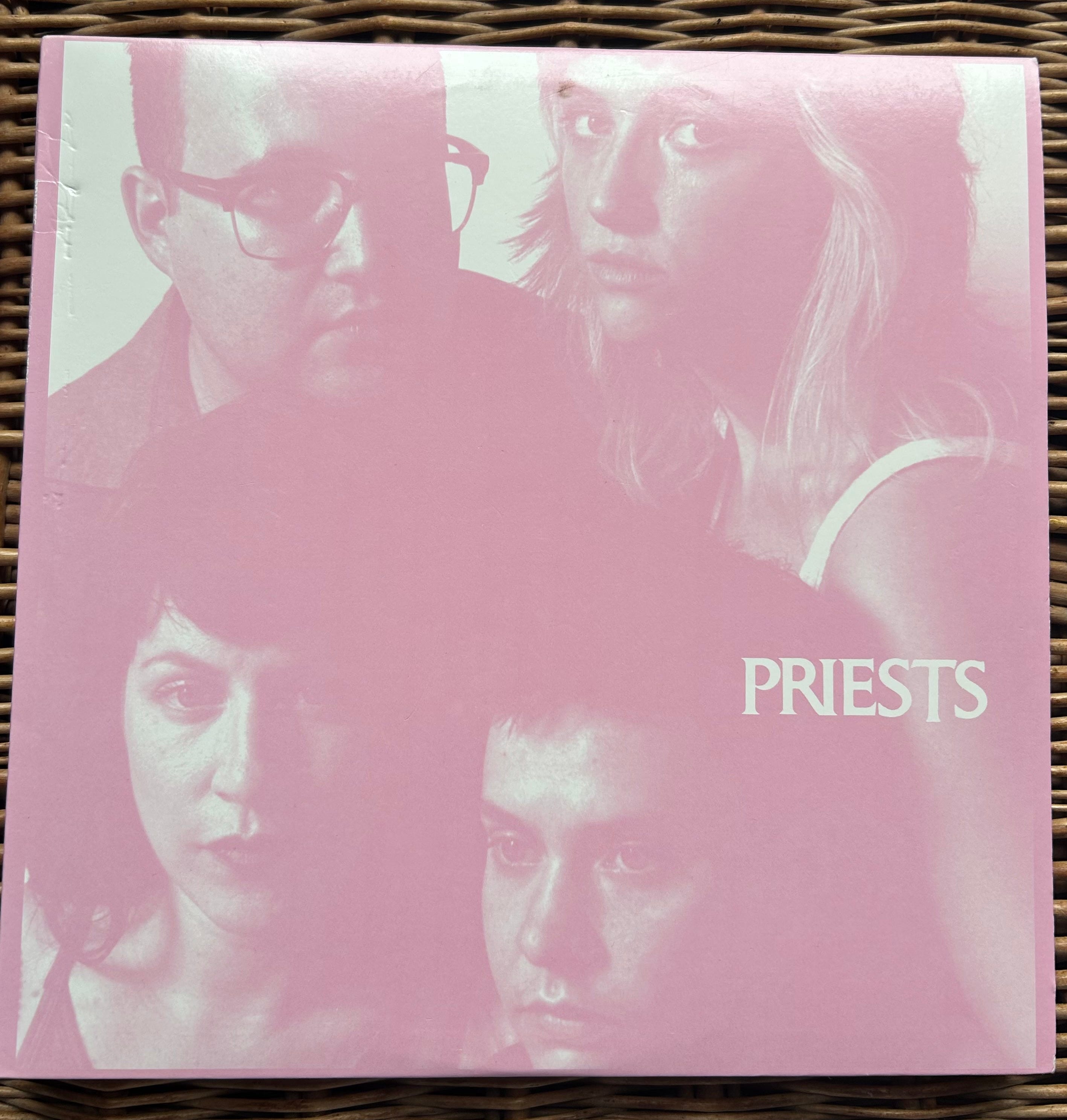
It was Priests that brought us to this conversation on March 4, one week after I had gotten laid off from my job, came home in an insane state, and blasted Nothing Feels Natural, their proper debut LP from 2017. It’s one of my favorite albums (I show Greer my copy, gushing, and she is very happy with my fandom) because it is blissful freedom; it seems like a free-jazz album.
We’re both obsessed with music; it’s our number one source of freedom and inspiration. We both have Political Science degrees, but we lost faith in the system after seeing how the sausage was made. We chose music to our parents’ chagrin.
“I have always listened to all kinds of music, and my past bandmates are fans of all kinds of music,” says Greer, sitting in the corner desk area of her Los Angeles home, amongst floral wallpaper, writing stuff, a pocket calculator, a synthesizer, and a reproduction of one of the posters from World Expo ‘70, held in Osaka, Japan in 1970. “None of us were jazz musicians, but we were trying to bring that type of feeling to it. I love that you said how freeing it made you feel because that was always a liberating spirit, always what we wanted to bring.”
Nothing Feels Natural is a rush. Greer wants to talk about her new album, but we gotta get nostalgic first. The third track off her debut solo album, Barbarism (2022), is titled “Fake Nostalgia.” Priests’ nostalgia is VERY REAL.
Greer gasps. I mention Priests’ obliterating live set at Pitchfork Festival 2017, which we can easily transport back to on YouTube. It was a hard, early-day performance that set the bar.
“Oh, my God,” Greer exclaims. “We were definitely at the peak of how much we were touring and how busy we were. We had worked so hard with that band to make it sustainable, to just make it functional; it’s so hard to make a band work.”
After touring the hell out of Nothing Feels Natural, Priests went on to work with top producer John Congleton for The Seduction of Kansas, which may have flipped the script on what Priests did previously, but it’s a great album by a phenomenal rock band.
Greer is glad that her music can bring someone to a totally free place, even if they’re not feeling too well about things. Music is our most abiding love.
“If you can’t do it with feeling—don’t.”
—Patsy Cline
When Priests called it quits at the end of 2019, it felt very abrupt, as if a train of progression derailed. But the fans weren’t seeing all the drama happening within the band of four individuals.
“Yeah, it’s really hard to be in a band,” Greer says. “It’s really hard to run a record label [Sister Polygon] together, too.”
Greer pauses for a second and lets out a sigh. “Yeah, money makes things hard. Some people are saying we really need to get the next record out quicker, they don’t have the time to get another job. Some people are saying, ‘quit rushing me, I need to work on my contributions to this record.’”
Congleton is a very respected, hard-working producer, and Greer says that he helped hold Priests together a little bit longer. “He’s the best, he’s an incredible person. But I don’t think bands are meant to last forever, and there are still times when I miss that period so much. I realized now that the grief and sadness I feel for it not existing anymore is more of a testament to the love I have for it. That band and that time in my life is so special to me, but I don’t think I would go back to it. I am happy with what I am making right now. I think the world and circumstances we’re all working in are vastly different, or feel vastly different to me than 10 years ago.”
Perfect Woman Sound Machine, which features a Leonard Cohen cover (“I’m Your Man”), ebbs and flows with Greer’s signature depth. A gifted songwriter doesn’t necessarily need a band, but I am seeing her get choked up with honesty about her former band.
Priests were in band therapy, Greer says; they had a band therapist. “He was an amazing man. Yes, people made the Metallica: Some Kind of Monster jokes, but like in any close relationship, you really have to work on your communication skills, listening skills—it was, and it wasn’t working out. I eventually said that I don’t think I could keep doing this.”
Greer got really sick on a tour, so sick that Priests had to cancel a show in Bloomington, Indiana. “I went to the urgent care, and they said I was really dehydrated, which made no sense because I carry a big water bottle with me wherever I go; I am a very hydrated person. So, that was the moment I realized, wow, I am so caught up in trying to make this work that I am not able to fully take care of myself.”
She was losing it. She had to stay with her parents in rural Tennessee for a few weeks. She went on antidepressants.
“The things I needed to do to keep functioning with this project [Priests] were hurting me,” says Greer. “There wasn’t an enemy; we were all trying our best to make it work. It’s really hard to do that.”
Another factor: a rotating cast of bass players filling in for Taylor Mulitz, who was (still is?) in another band, Flasher. Greer says she just talked to Daniele Daniele (drums) the other day; she has a baby now.
“We’re all in different phases of our lives. I love Priests so much, and I am so happy that that band brings joy and liberation to people, still.”

Perfect Woman Sound Machine enters cosmic territory. “Nobody Knows How I Reach You But I Do” seems as if Greer is coming to us from a different planet. It was produced by Meg Searl, who makes music under the moniker Lilith 181, and makes me think of Half Free by U.S. Girls (Meg Remy).
“Any comparison to Meg Remy is such a freakin’ honor,” Greer says. “I know her a little bit from when the pandemic happened, and Sister Polygon was still around. We tried a very brief online variety show, and Meg contributed a short video about planting seeds in her garden at home and watching them grow. It was a very uplifting message about, despite us all being stuck at home, it doesn’t mean things aren’t growing and happening.”
I met Remy in 2013 when she was touring with a tape recorder in a suitcase, taking buses around the country. Greer saw the same tour and remembers U.S. Girls’ cover of "The Boy is Mine" by Brandy and Monica. Remy started her tape recorder and commanded the stage in a trance-including moment; she’s one of the great modern artists.
“I love it when you see or hear music that makes you feel like you didn’t know you were allowed to do that, almost like it doesn’t make sense,” says Greer. “The first track off Half Free, ‘Sororal Feelings,’ still blows my mind. She’s so cool.”
Half Free has Thriller vibes at a certain point, and “Damn That Valley” bangs totality. Greer should make a song like that…she says she’d love to.
“With Priests, I think Gideon [GL Jaguar] and I, in particular, were always trying to make our music sound more like Portishead, and if I had to pick, maybe Portishead is my favorite band,” Greer says. “So, there’s a part of me that is always treating them as a North Star. I don’t think I really honed in on that too much, but it’s always an influence.”
U.S. Girls, Broadcast (Tender Buttons), Scott Walker, J Dilla, Kim Gordon, and Cleveland proto-punk are the eclectic supremacy Greer is channeling lately. Perfect Woman Sound Machine begins with “Expo 70,” and the first vocals are Greer, pitch down, whispering “pow, pow,” similar to something Scott Walker did on “Jesse” from The Drift (2006).
“He’s singing about the Twin Towers falling from Elvis’ dead stillborn twins' perspective, I know, it’s insane,” Greer says of Walker, who died at 76 in 2019. “He does a pow-pow thing, and I wanted to bring that in. I have always loved Kim Gordon’s work, and the way she plays with these lofty, artistic concepts and really harsh sounds, especially her more recent work. I was definitely trying to channel some of that.”
The best artists are those who progress, never stay in one lane; their closet of clothes is filled with all different colors, and they throw them around. It’s psychedelic fashion, playing different characters. Greer is not a technical genius with instruments; she writes out ideas and performs.
When you cross-pollinate between scenes, it’s almost impossible to make one style of music. Greer grew up in Metro Detroit, flourished in Washington, D.C., and chilled out in Los Angeles. She loves the 77’ punk—Rocket From The Tombs, Pere Ubu, the Stooges, Protomartyr—but is most inspired by the rich history of D.C. She mentions Go-Go from the 1970s.
“It’s fascinating, if you ever want to go down a rabbit hole,” says Greer. “Around the time that record executives were looking at hip-hop as a mass-market thing, they also thought that about Go-Go. It worked for hip-hop, but it never really did for Go-Go.”
The rolling funk rhythm of "One Thing" by Amerie is very Go-Go, Greer says. Put the drums on repeat.
“There’s so much music in D.C. It never occurred to me to make one style of music.”
Greer’s solo music is a rolling trip of feelings. Her voice is instantly recognizable, but changes pitch frequently; she’s an artist. She’s not going crazy in front of a rock band anymore, but she’s constructing her own cohesive soundscapes. Listening to her new songs on repeat almost toppled this entire article.

The Perfect Woman Sound Machine title stems from when Priests played Coachella. While driving through the Coachella Valley in Southern California, they stopped at a gas station novelty store, and Greer got a novelty toy named Perfect Woman Sound Machine.
“The idea is that it’s a gift for a guy, or someone who doesn’t need a girlfriend; you can just have this little box and press the buttons,” says Greer, ready to replicate the voice of the toy. “She says stuff like, ‘Yes, baby, those asshole cops,’ or ‘no, I never want to go shopping again,’ or ‘I would love to give you a blowjob.’ Just stupid shit like that. A Perfect Woman Sound Machine is such a cool-sounding thing. I wanted to make a record where you press a button, and you get a different sound, short story, or character.”
She did that. She’s so awesome. Repeated listens put me into hypnosis; it’s relatively dangerous. She has chilled out, but her music is sinister, too.
“First of all, when I was young, I was nervous on stage,” Greer says. “It was easier when I felt nervous to write songs where I was yelling. You’re less vulnerable when you’re freaking out, but over time, I would always lose my voice on tour. No question. I would have to not talk until the show, otherwise no sound would come out.”
Greer wanted to sing more. She loves singing. She’s so amazing at singing. “I like yelling and being crazy, too, but I don’t want to make one kind of music. I don’t want to use my voice in just one way, and my songs are from a frustrated short story writer—each one is a different character, different plot line.”
The Priests character is such a part of her, but Greer doesn’t want to play it all the time. I ask her how many characters she likes to play, and we both laugh out loud.
“I don’t know…I was really into theater as a kid. Before I got really into punk, I loved music, but thought that I couldn’t make music; I didn’t know how. But I loved acting, so in some ways, I am always looking for different characters to explore authentic feelings or experiences I am having.”
Greer is not a diary-style songwriter. She doesn’t usually write a song after something bad happens to her. She translates the feeling authentically by, for example, coming up with a character who really wants to get a hold of someone named Leslie (“Talk To Leslie”).
In Greer’s mind, Leslie is in jail, and the narrator of the song probably got Leslie into jail. She’s calling to say sorry. “Like, I’m obsessed with you, I miss you, and I know that you still want to talk to me. Who knows how Leslie is reacting…I never had that experience, but the emotions are coming from a real place.”
Unfortunately, Greer has never been to a World Expo, but she made “Expo 70” after learning about the Osaka World Expo of 1970. The theme was Progress and Harmony for Mankind. All the countries were submitting inventions, companies, or buildings that they felt oriented humanity towards a more progressive, harmonious future.
“It was beautiful to see all these ideas that people had, the optimism they had for the world getting better, both with technology and with world peace,” says Greer. “But the world has been such a flaming bag of shit in recent years.”
Yeah. It fucking sucks, huh?
“Especially with technology,” Greer says. “As long as capitalism exists, technology will always be exploited by those who have a billion dollars.”
Authentic people like us need to keep going further with our authenticity. The more authentic we get, the more freaked out the billionaires may become. We could create a version of social war.
“Should I be living with my eyes closed?”
—Katie Alice Greer in “Expo 70”
“Nowadays, it seems like progress is always the code word for some AI data center that is stealing our shit,” says Greer. “Is progress contradictory? Should I be looking backwards, living with my eyes closed, to learn about and figure out how to make a better future? I don’t know.”

If time travel actually becomes a thing, what year would you go back to?
“Oh, man…when was…no, I don’t know…” Greer thinks, maybe bites her lip. She was going to make a joke about going back to kill Baby Hitler or Baby Trump. “I don’t actually think that…we would have to…any time people get wrapped up in…”
As much as going back in time to kill any person who became a ruthless dictator would have helped our society, we’re not condoning murder. We’re just going off on a tangent; we went off on tangents this whole time. We’re jumping around. We’re excited. The sun is right in my fucking face.
“We have to attack the root cause of this ideology, these people,” says Greer, who is not going to pick a year. “At least in the 1990s, in the United States, we were all living with blinders on. Not all of us, but if you came from a white family, came from a certain socioeconomic background, it seems like people were chilling, thinking that things were great, probably until 9-11. Then, it’s like, wait, some people might be mad at us for how we treat the rest of the world.”
Greer is OK dealing with right now, even if it is not fun.
“On the best days, I am curious to find out what is going to happen tomorrow. On the worst days, I say, ‘damn, this is a real problem for all of us to solve, I don’t know how we’re going to do it.’ But I do think orienting towards collectivity and connecting with each other, and not isolating, is always the way forward.”


Greer on Opening Night, Gena Rowlands, and John Cassavetes, which has influenced her work:
“It’s just one of the greatest actors doing her thing; she goes absolutely nuts. I highly recommend the movie and any Cassavetes. He and Rowlands are big inspirations for how I write songs. They create these characters who feel so emotionally authentic. It was a totally different style of acting than what was common at the time, and you see their filmmaking influence totally change the landscape afterwards. The movie is about an actress’s work challenges: her sense of reality and fiction become blurred.”
On the lyrics for “Unglued” :
“It’s about feeling like you’re never satisfied, always wanting more, the times when you feel insatiable. Our culture of consumerism doesn’t encourage feeling any other way. North American and Western European white culture is all about the never-ending conquest, manifest destiny, a sort of politics of greed that justifies imperial conquest of everyone and everything. I think even those of us who detest these values can’t escape them; they play out in our personal lives and feelings sometimes, too.”
Greer can’t say much about the second volume of Perfect Woman Sound Machine, but she says she and Searl recorded twice as many songs as are on volume one.
She’s distracted by playing games on her phone:
“I play Color Block Jam. I am currently stuck on level 132. I refuse to ever pay for these kinds of games, so occasionally I have to watch ads for deranged games like Gossip Harbor. The game seems to be about a woman whose wealthy husband divorces her and kicks her and their child out to the street. You have to ‘help’ the mother rebuild her life. It looks absolutely fucking insane, and I am fascinated by it and the style of ads for it that Color Block Jam forces me to watch, but not fascinated enough to download the game.”
Priests sits next to Portishead in my record collection, by the way. You’ll understand if you were reading properly.
Barbarism came out in 2022. Greer has moved twice since then around Los Angeles. She’s had a succession of various day jobs at various times: event coordinator, podcast producer, personal assistant, and social media for local businesses.
“Learning all these required skills for all this work has kept me pretty overwhelmed,” Greer says. “I’m trying to get back to a life that focuses on making music and makes space for the small business of getting it out in the world. But everything costs a lot of money! Constant Tetris game of trying to do the things I need to do to make enough of it!”